


The answer depends on whether the tattoo is healing or fully healed. On a healing tattoo, the answer is no — to everything. On a healed tattoo, the answer depends on the specific ingredient, and some of the most popular anti-aging actives can fade ink over time even on skin that's been healed for years.
In this article
- Anti-aging products on a healing tattoo
- Anti-aging products on a healed tattoo
- What retinol does to tattoo ink
- AHAs, BHAs, and tattoos
- A tattoo-safe routine
- FAQ
Anti-Aging Products on a Healing Tattoo
Keep every anti-aging active away from a healing tattoo. No exceptions during the healing period (typically two to four weeks for surface healing; up to three months for the deeper layers to fully settle).
Retinoids, AHAs, BHAs, vitamin C serums, niacinamide at active concentrations, and any exfoliating acid all irritate an open wound. They compromise the skin barrier, disrupt the skin's pH, and interfere with the cell turnover process that's supposed to seal the tattoo cleanly beneath a new epidermis. They also increase the risk of ink loss during the healing phase, since any disruption to the forming skin layer pulls pigment toward the surface before it's settled into the dermis.
During healing: use only your tattoo-specific aftercare products and nothing else on the tattooed area. Once healing is complete, you can reintroduce your skincare routine, with some caveats.
Anti-Aging Products on a Healed Tattoo
A fully healed tattoo — no scabbing, no peeling, skin texture identical to the surrounding area — can tolerate most skincare products without immediate damage. But a subset of popular anti-aging ingredients gradually accelerate the fading of tattoo ink over months and years by increasing the rate at which the skin renews itself.
What Retinol Does to Tattoo Ink
Retinoids (retinol, retinal, tretinoin, adapalene) work by dramatically speeding up epidermal cell turnover. New cells form faster, old cells shed more quickly, and the surface texture of the skin improves. This is exactly what makes retinoids effective for fine lines, texture, and acne.
The problem for tattoos is that tattoo ink isn't entirely in the dermis. Some particles settle into the lower layers of the epidermis during healing. When the epidermis renews itself on an accelerated schedule — which retinoids cause — those surface-layer ink particles shed away faster than they would naturally. The result, over months of regular retinoid use, is progressive fading in the tattooed area. Vibrant color loses saturation. Fine linework loses crispness. The tattoo ages faster than it would have without the retinoid use.
The stronger the retinoid, the faster this happens. Prescription-strength tretinoin causes more accelerated fading than over-the-counter retinol, though the principle is the same across the category. If you use retinoids regularly, apply them everywhere on your face or body except over healed tattoos.
AHAs, BHAs, and Tattoos
Alpha hydroxy acids (glycolic, lactic, mandelic) and beta hydroxy acids (salicylic) are chemical exfoliants that dissolve the bonds between dead surface skin cells. Regular use smooths texture and brightens skin tone. Like retinoids, they accelerate the shedding of the upper epidermal layers, which over time pulls surface-embedded ink particles away faster than normal skin renewal would.
AHAs and BHAs used occasionally and at lower concentrations cause less cumulative damage to tattoo ink than retinoids. High-strength chemical peels applied over healed tattoos, however, can cause significant immediate fading — a 30% glycolic peel over a tattooed area is not appropriate. At typical serum concentrations (5 to 10% glycolic, 1 to 2% salicylic), the fading effect accumulates slowly. If you use acid-based toners or exfoliants regularly, avoid applying them directly over tattoos. Use them on the surrounding skin and skip the tattooed area in your routine.
A Tattoo-Safe Routine
The ingredients that protect and nourish healed tattoo ink are the opposite of exfoliating actives: barrier-supporting, moisture-retaining, and UV-protective.
Nourishing balm or ceramide-based moisturizer. Deeply moisturized skin retains ink better than dry, depleted skin. A rich balm or lotion with ceramides and fatty acids supports the skin barrier and keeps the dermis in good condition, which slows the natural fading process. Apply over tattooed areas daily.
SPF 30 or higher, every time the tattoo is exposed to sun. UV radiation is the primary driver of tattoo fading. No other measure comes close to the impact of consistent broad-spectrum sun protection on tattooed skin. Daily SPF on sun-exposed placements does more to preserve tattoo vibrancy long-term than almost any other variable you control.
Your anti-aging actives applied everywhere else. Continue using retinoids, AHAs, and BHAs on your overall skin. Just apply them around the tattooed area rather than over it. This is an easy pattern to add to any routine and lets you benefit from actives without sacrificing ink longevity.

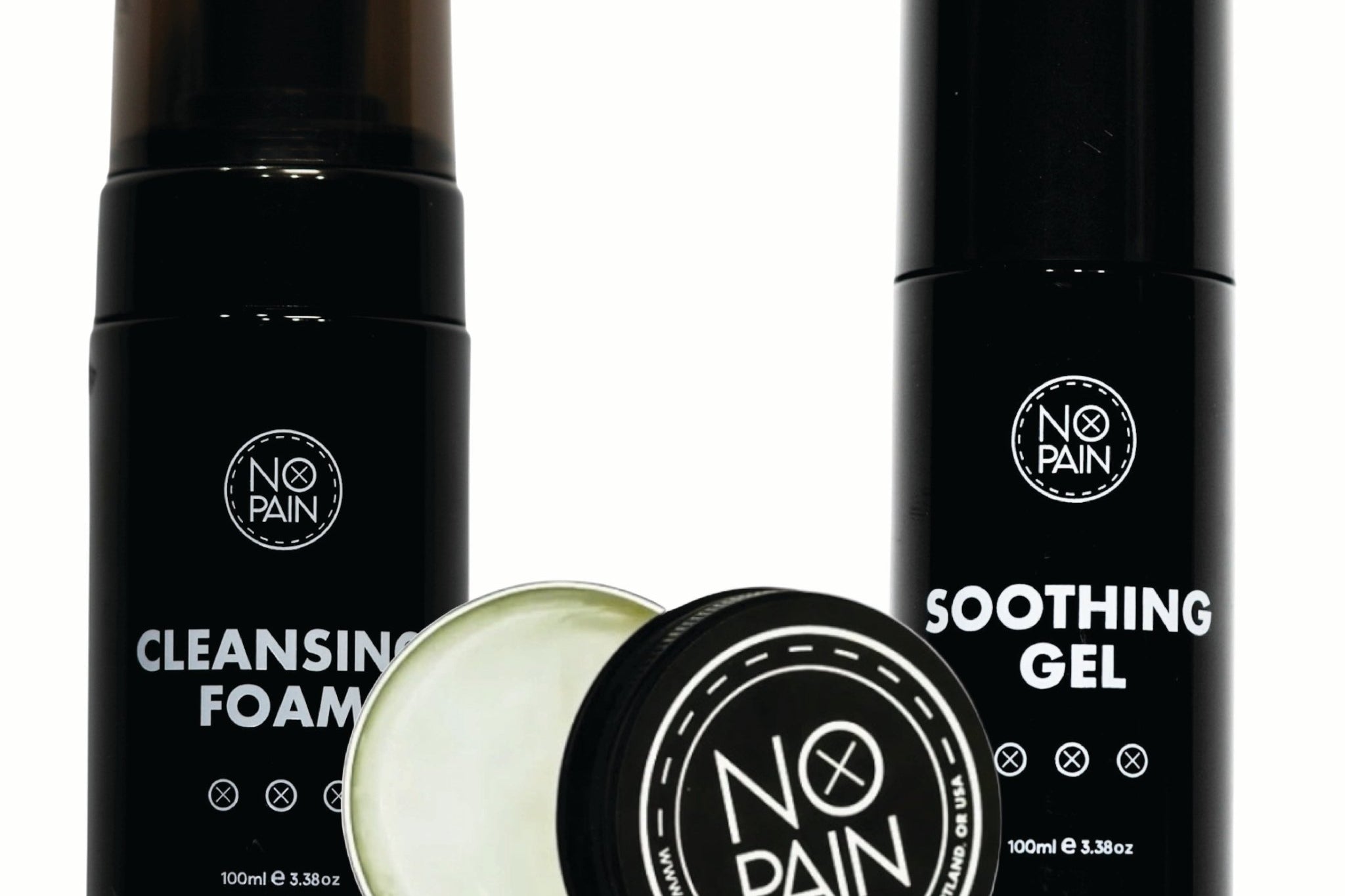
The nourishing balm in the bundle is designed for ongoing tattooed skin care, not just the healing phase. Fragrance-free, free of any actives that accelerate fading, and formulated to support long-term ink retention.
FAQ
Can I use vitamin C serum over a healed tattoo?
Vitamin C serums vary significantly in formulation. Ascorbic acid (L-ascorbic acid) at active concentrations of 10% to 20% is an exfoliant as well as an antioxidant, and regular use over tattooed skin can gradually fade ink. Vitamin C derivatives like ascorbyl glucoside or magnesium ascorbyl phosphate are more stable and gentler, with much lower exfoliant activity. If you use a vitamin C product, check the concentration and form. Lower-concentration derivatives applied occasionally are unlikely to cause meaningful fading. A high-strength L-ascorbic acid applied daily directly over tattooed skin will accelerate fading over time.
Can I use tretinoin near a tattoo?
You can use tretinoin anywhere that isn't directly over the tattooed area. Apply it as close to the edges as you normally would, but skip the skin directly above the tattoo. The ink is in the dermis beneath the skin you're applying the product to — keeping tretinoin off the tattooed zone prevents the accelerated cell turnover in that specific area while still letting you benefit from it everywhere else.
Does niacinamide fade tattoos?
Niacinamide at typical over-the-counter concentrations (4 to 10%) is not an exfoliant and does not accelerate cell turnover. It's a very different active from retinoids or acids. Standard niacinamide use over healed tattoos is generally considered safe for ink retention. High-strength clinical formulations are less commonly used in daily skincare, and the effects at those concentrations are less well established. At typical product concentrations, niacinamide is not in the same risk category as retinoids or AHAs for tattoo fading.
What about self-tanner over a tattoo?
Self-tanner does not fade tattoo ink. The active ingredient (DHA) reacts with amino acids on the skin's surface to create a brown color effect; it doesn't penetrate to the dermis or accelerate cell turnover. Self-tanner applied over a healed tattoo will temporarily change the color appearance of the skin above the tattoo, which can make the design look slightly different until it fades. It won't damage the ink. The tattoo will look normal again once the tan fades. Note: actual UV tanning — whether from sun exposure or tanning beds — does fade tattoo ink significantly and is worth avoiding on tattooed skin.
How long after a tattoo can I use retinol again?
Wait until the tattoo is fully healed before reintroducing retinoids to your routine over that area. Surface healing takes two to four weeks — no scabbing, no peeling, no shiny or waxy texture, skin feeling identical to the surrounding area. Some dermatologists recommend waiting a full three months for the deeper layers to settle completely before using strong actives over the area. When you reintroduce retinoids, apply them around the tattoo rather than over it as a long-term habit.
Do chemical peels ruin tattoos?
A professional chemical peel applied directly over a healed tattoo can cause significant, immediate fading. The exfoliation depth of a medium or deep peel removes more than the very surface layer of the epidermis, taking surface-embedded ink particles with it. If you are having a professional peel, tell your aesthetician about any tattoos in the treatment area so they can mask or avoid them. Light peels at very low concentrations have a lower risk, but treating a tattooed area with a peel of any strength is still not best practice for ink retention.
Protect What Your Artist Put In
The Aftercare Bundle gives you the right products for healing and ongoing care, with no actives that accelerate fading.
Shop the Aftercare Bundle →Formulated at Historic Tattoo in Portland, Oregon. 100% money-back guarantee.