



A stick and poke tattoo is made by hand, without a machine. The artist dips a needle in tattoo ink and pushes it into the skin one puncture at a time: no buzzing, no motor, just a needle and patience applied dot by dot.
The technique predates the electric tattoo machine by thousands of years, and it's more popular today than at any point in the last century. This guide covers what stick and poke tattoos are, how they compare to machine work, whether they actually fade faster, which styles suit the technique best, and the aftercare that determines how long yours will last.
In this guide
- What is a stick and poke tattoo?
- A brief history
- Stick and poke vs. machine tattoos
- Do stick and poke tattoos fade faster?
- Stick and poke tattoo ideas
- What goes into a stick and poke tattoo
- Aftercare for stick and poke tattoos
- FAQ
What is a stick and poke tattoo?
A stick and poke tattoo (also called a hand poke tattoo) is created by manually pushing ink into the dermis using a needle, without a rotary or coil machine. The artist controls depth and pressure directly with their hand, placing each dot individually. It is slower, more deliberate, and more dependent on the artist's tactile judgment than machine tattooing.
The result tends toward the handmade: slightly organic lines, visible dot texture in shaded areas, a quality that's distinct from the mechanical smoothness of machine work. Some artists and clients prefer this aesthetic precisely because it looks like it was made by hand.
Stick and poke exists across a wide range today: self-administered home tattoos between friends, dedicated hand poke specialists working in professional studios, and a recognized aesthetic movement in the tattoo world built around the technique and its history.
A brief history
Stick and poke isn't a revival of something fringe. It's the original form of tattooing.
The oldest tattooed human remains belong to Ötzi the Iceman, a Copper Age man whose preserved body was discovered in the Alps in 1991. His tattoos, over 60 marks made from carbon rubbed into small incisions, date back more than 5,000 years. They were made by hand.

Across cultures and centuries, the same basic method appears: ink or pigment introduced into the skin by hand, one puncture at a time. Polynesian tatau traditions used bone and shell combs tapped with a mallet. Indigenous peoples across the Americas, Asia, and the Pacific developed their own variations on the same principle. The electric tattoo machine wasn't invented until 1891. Every tattoo in human history before that was a hand poke.
No Pain Tattoo founder Michael Hollman got his first tattoo this way. He was 15 years old, on a hike with a friend to the top of a mountain. When they reached the summit, his friend pulled a small kit from his bag and asked if he wanted a tattoo. He said yes. Looking back, it wasn't the most sterile environment, and it's not something he'd replicate today. But it was spontaneous and memorable in a way a studio piece rarely is. That experience is part of what eventually led him to start No Pain Tattoo: the belief that every tattoo has a story worth protecting, regardless of where or how it was made.
Stick and poke vs. machine tattoos
Both methods deposit ink in the same layer of skin (the dermis), but the experience and results differ in a few practical ways.
Speed. Machine tattoos are faster. A coil or rotary machine operates at hundreds to thousands of needle strikes per minute. A hand poke artist works at whatever pace their hand can maintain. A design that takes 30 minutes by machine might take two hours by hand.
Feel. Many people describe hand poke as less intense than a machine: more of a repetitive pressure than the vibrating sting of a machine. Others find it sharper but more predictable. Neither description applies to everyone, and placement affects both experiences more than the technique does.
Healing. Machine and hand poke tattoos heal on similar timelines. Both create an open wound in the dermis. Both need the same aftercare. The method doesn't change the biology.
Aesthetic results. Machine tattoos can achieve smooth gradients and high saturation more readily. Stick and poke lends itself to minimalist linework, dotwork shading, and illustrative styles where the handmade quality is part of the design rather than a limitation of it.
Do stick and poke tattoos fade faster?
This is the most common concern, and the honest answer is: no, not inherently. A well-executed stick and poke tattoo, with ink placed correctly in the dermis, lasts the same way a machine tattoo does. The ink is in the same layer of skin. It doesn't know how it got there.
The reputation for fading faster has real causes, but they're not specific to the technique:
Ink depth. Getting ink into the dermis consistently is a skill. Too shallow (in the epidermis), and the ink sheds away as skin renews itself. Too deep, and it blurs. Both problems happen with machine tattoos done by inexperienced artists. They're more common in stick and poke because manual depth control is harder to master than machine tattooing. An untrained hand places ink inconsistently. An experienced hand poke artist places it just as reliably as any machine artist.
Ink type. Using pen ink, India ink, or anything not formulated for skin is a serious mistake. These inks are not stable in the body. They fade unevenly, break down unpredictably, and carry real infection risk. Tattoo-grade ink is the only appropriate option, regardless of who is doing the work.
Aftercare. A poorly healed tattoo loses ink. The fine dots of a stick and poke show this more obviously than denser machine work, because there's less ink per unit area to begin with. Proper aftercare is what keeps the ink where it was placed.
Stick and poke tattoo ideas
The technique suits some styles considerably better than others. The handmade quality works with, not against, the following:
Minimalist linework. A single clean line, a simple shape, a small outline. The slight organic quality of hand-drawn work adds character that many people prefer over the mechanical precision of a machine line.
Dotwork and stippling. Stick and poke is literally a dotwork tool. Artists who specialize in dotwork shading, building tone through dot density rather than solid fill, have a natural connection to the technique. The results can be exceptional.
Botanical and floral designs. Delicate leaves, stems, petals, and small botanicals suit the fine, airy quality of hand poke linework. A small sprig of rosemary or a single flower head is a classic application.
Geometric and sacred geometry. Circles, triangles, hexagons, and more complex sacred geometry designs work well when sized appropriately. The slow, deliberate pace of hand poking suits the focus these designs require.
Small text and script. Single words, initials, short phrases. Keep it simple. Fine script gets harder to execute cleanly at small sizes, by hand or by machine.
Symbols and small motifs. A crescent moon, a single star, a small arrow, a wave. These are among the most common stick and poke subjects and work well because the designs are forgiving of the slight imprecision inherent in the technique.
Stick and poke is less suited to large highly saturated pieces, complex realism, or designs that rely on smooth color gradients. If you want something in those categories, a machine artist is the right tool for the job.
What goes into a stick and poke tattoo
Whether you're having one done by a professional hand poke artist or at home, understanding the basics helps you evaluate whether the setup is safe.
Tattoo-grade ink. Not pen ink. Not India ink. Cosmetic-grade tattoo ink formulated for use in skin. There is no acceptable substitute. Wrong ink causes infections and fades unpredictably.
Sterile single-use needles. From sealed packaging. Never reused, never shared. A fresh needle for each session.
Clean workspace and skin prep. A disinfected surface, skin washed and alcohol-wiped before starting, fresh gloves for the person doing the work.
If you're visiting a professional hand poke artist, they should be able to show you their ink brand, sealed needle packaging, and clean setup without hesitation. If they're reluctant or unclear, that's the answer.
If you're doing it yourself at home: the same standards apply. The difference between a clean stick and poke and an infected one is almost always hygiene, not technique.
Aftercare for stick and poke tattoos
Stick and poke aftercare is identical to machine tattoo aftercare, and it matters just as much. The method used to create the tattoo doesn't change what happens to the skin afterward. It's an open wound healing in the dermis, same as any other tattoo.
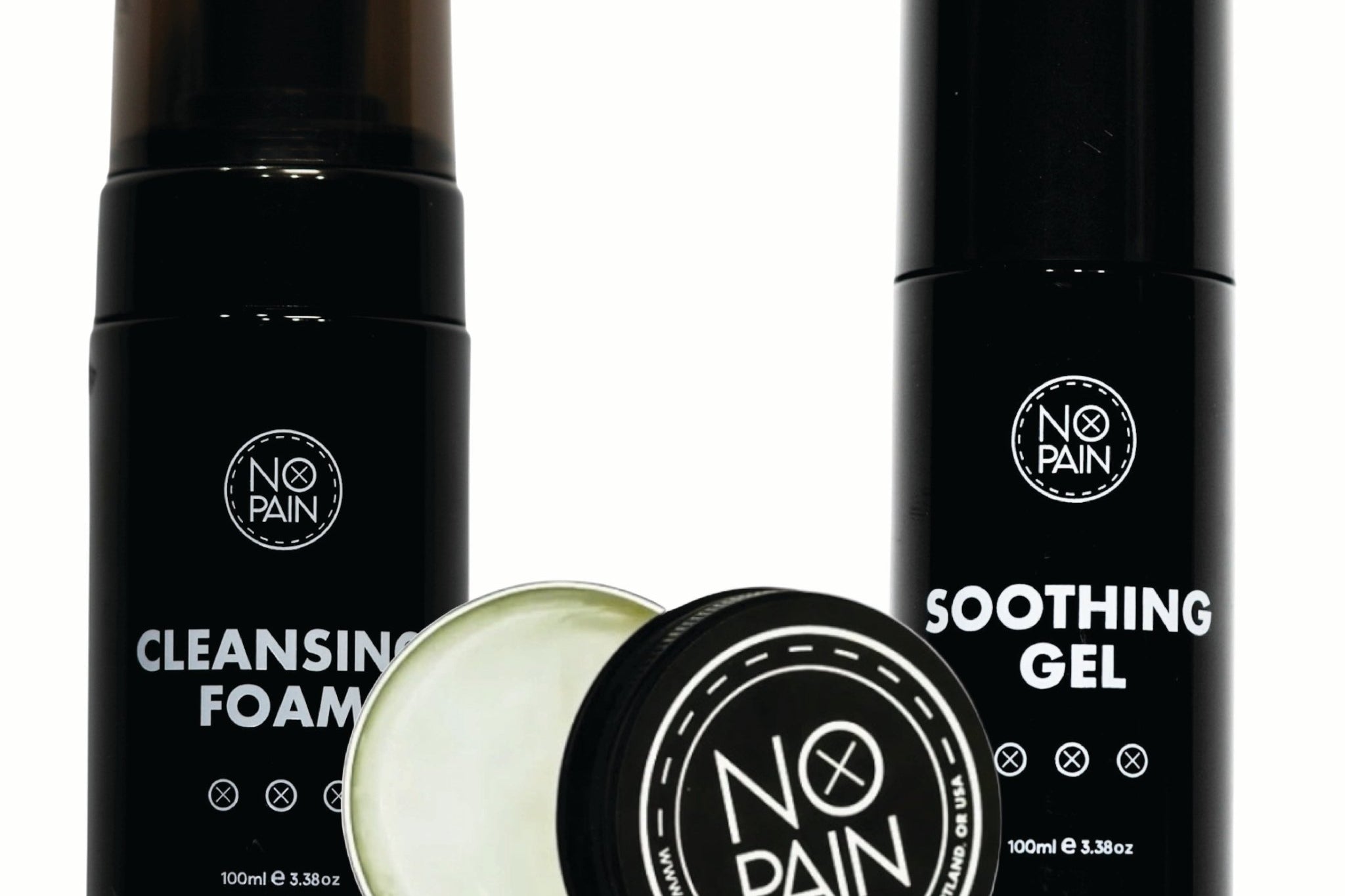
For the first three to six days: wash twice daily with fragrance-free liquid soap, pat dry with a paper towel, and apply a thin layer of soothing gel. The gel maintains the right moisture level for the surface to close without forming heavy scabs. On fine linework and dot patterns, a raised scab pulling free unevenly can take ink with it and leave a visible gap.

Cooling, lightweight moisture for the first week. Apply a thin layer after every wash to keep the surface healing cleanly without heavy scabbing. Fine linework and dot patterns heal best when the surface stays just moist enough: not coated, just covered. Backed by a money-back guarantee.
Shop Soothing Gel: $15
Around day two or three, switch to an aftercare balm. The balm's oil-and-butter base nourishes the healing layers without occluding them, which is the right approach as the peeling and settling phase begins.
Long-term: apply sunscreen over healed stick and poke work. Fine linework and small dots are among the first details to show UV degradation. Soft lines and faded dots are harder to touch up in a hand poke piece than in machine work because matching existing hand-placed dots precisely is difficult. Consistent sun protection is the simplest way to protect what's there.

No Pain Tattoo Aftercare Bundle
Soothing gel for the first week, aftercare balm for week two, and cleansing foam for daily washing. Everything your stick and poke needs to heal cleanly and keep every dot exactly where it was placed. Backed by a money-back guarantee.
Shop Aftercare Bundle: $33.60FAQ
Do stick and poke tattoos fade faster than machine tattoos?
Not inherently. A stick and poke tattoo with ink placed correctly in the dermis lasts the same way a machine tattoo does. The perception that they fade faster comes from inconsistent ink depth (a technique problem), wrong ink types like pen or India ink (a materials problem), and poor aftercare (a healing problem). All three are avoidable. A well-executed hand poke tattoo from an experienced artist, healed properly, has the same longevity as machine work.
How long does a stick and poke tattoo last?
Indefinitely, if done correctly. The ink is in the dermis, the same permanent layer that machine tattoos target. Fine linework and small dots will soften over years as the skin changes and ink gradually disperses at the edges, the same as any fine-line machine tattoo. UV exposure and placement affect longevity more than the technique does. Sun protection and good aftercare are the main variables within your control.
Can I do a stick and poke tattoo at home?
People do. The risks are real: infection from unsterile equipment or wrong ink, inconsistent depth that leads to fading or blowout, and results that are difficult to fix or cover. If you're doing one at home, the standards are the same as any professional setup: tattoo-grade ink, sterile single-use needles from sealed packaging, a disinfected workspace, clean skin prep, and fresh gloves. Shortcuts on any of those are where things go wrong.
What ink should I use for a stick and poke tattoo?
Tattoo-grade ink only. Pen ink and India ink are not formulated for use in the body. They break down unpredictably, fade unevenly, and carry infection risk. Cosmetic-grade tattoo ink from a reputable supplier is the only appropriate option. Black is the most stable color long-term; colored inks in fine linework may require touch-ups sooner.
What styles work best for stick and poke tattoos?
Minimalist linework, dotwork and stippling, small botanical and floral designs, geometric shapes, small text, and simple symbols are the styles best suited to the technique. Stick and poke is less appropriate for large saturated pieces, complex realism, or smooth color gradients. Those styles require the speed and consistency of a machine to execute well.
How do I care for a stick and poke tattoo after getting it?
The same way you'd care for any tattoo. Wash twice daily with fragrance-free liquid soap, pat dry, and apply soothing gel for the first three to six days. Switch to aftercare balm around day two or three as the peeling phase begins. Avoid soaking, picking, or sun exposure while healing. Once fully healed, apply SPF regularly. Fine linework and small dots are among the details most vulnerable to UV fading over time.