


Your tattoo is done. The artist has wrapped it, you've left the studio, and now every decision you make over the next few weeks determines how it looks for the rest of its life. Good aftercare means sharp lines, true color, and a smooth peel. Bad aftercare means blown-out lines, patchy color, and a heal that takes twice as long.
Here's exactly what to do, day by day.
Leaving the Studio (Day 0)
Your artist has covered the tattoo with either standard cling wrap or a second-skin adhesive bandage (like Saniderm or Tegaderm). These work differently.
Standard cling wrap: Leave on for two to four hours, then remove and wash. Don't re-wrap with cling film after the first wash unless your artist specifically told you to and only for the first night.
Second-skin adhesive: Leave on for 24 to 72 hours (follow your artist's guidance). The seal stays intact through showering. You'll see fluid pooling under it; that's plasma and excess ink, and it's normal. When you remove it, peel slowly from one corner and pull back against itself, not straight up.
During this window: don't touch the tattoo, don't show it to everyone, don't expose it to direct sun or soaking water. Keep it covered.
The First Wash
The first wash is the most important thing you'll do for your tattoo. Under the bandage, plasma and excess ink have pooled on the surface. If you leave that to dry, it forms thick, heavy scabs. Heavy scabs pull ink when they fall off. You don't want heavy scabs.
Here's the method:
1. Wash your hands first. Always. Before touching the tattoo at any point during healing.
2. Use a gentle, fragrance-free soap. No bar soap (bacteria collect on the surface), no scented body wash, no exfoliating anything. A fragrance-free liquid soap (Dial Gold, Dove Sensitive Skin) or a dedicated tattoo cleansing foam works. Lather in your palm first, then apply with your fingertips.
3. Wash gently with lukewarm water. Not hot. Fingertips only, no cloth or sponge. You're cleaning off plasma, not scrubbing.
4. Rinse until the slimy feel is gone. The plasma has a slightly slippery texture. Rinse until the water runs clean and the skin feels normal.
5. Pat dry with a clean paper towel. Not a bath towel (bacteria, lint). Paper towel only. Pat, don't wipe.
After drying, apply a thin layer of soothing gel. Not a thick coat. A sheen.
Days 1-3: The Gel Phase
For the first two to three days, your tattoo is inflamed. The skin is red, warm, and still weeping plasma. It looks like a bad sunburn and feels like one too.
What the skin needs at this stage is something that calms inflammation without blocking the wound from breathing. A lightweight gel is the right tool. A heavy balm at this stage traps moisture underneath the surface, softens the skin, and creates the right conditions for ink loss. Don't jump to balm yet.
Routine for Days 1-3:
Wash twice daily (morning and night), always with clean hands and gentle soap. After each wash, pat dry and apply a thin layer of gel. The goal: clean, lightly hydrated, breathing. Nothing more.
What's normal during this phase: redness, swelling, warmth, ongoing plasma weep, soreness that feels like a sunburn, ink that looks slightly faded or washed out (the swelling distorts how it looks). All of this settles.

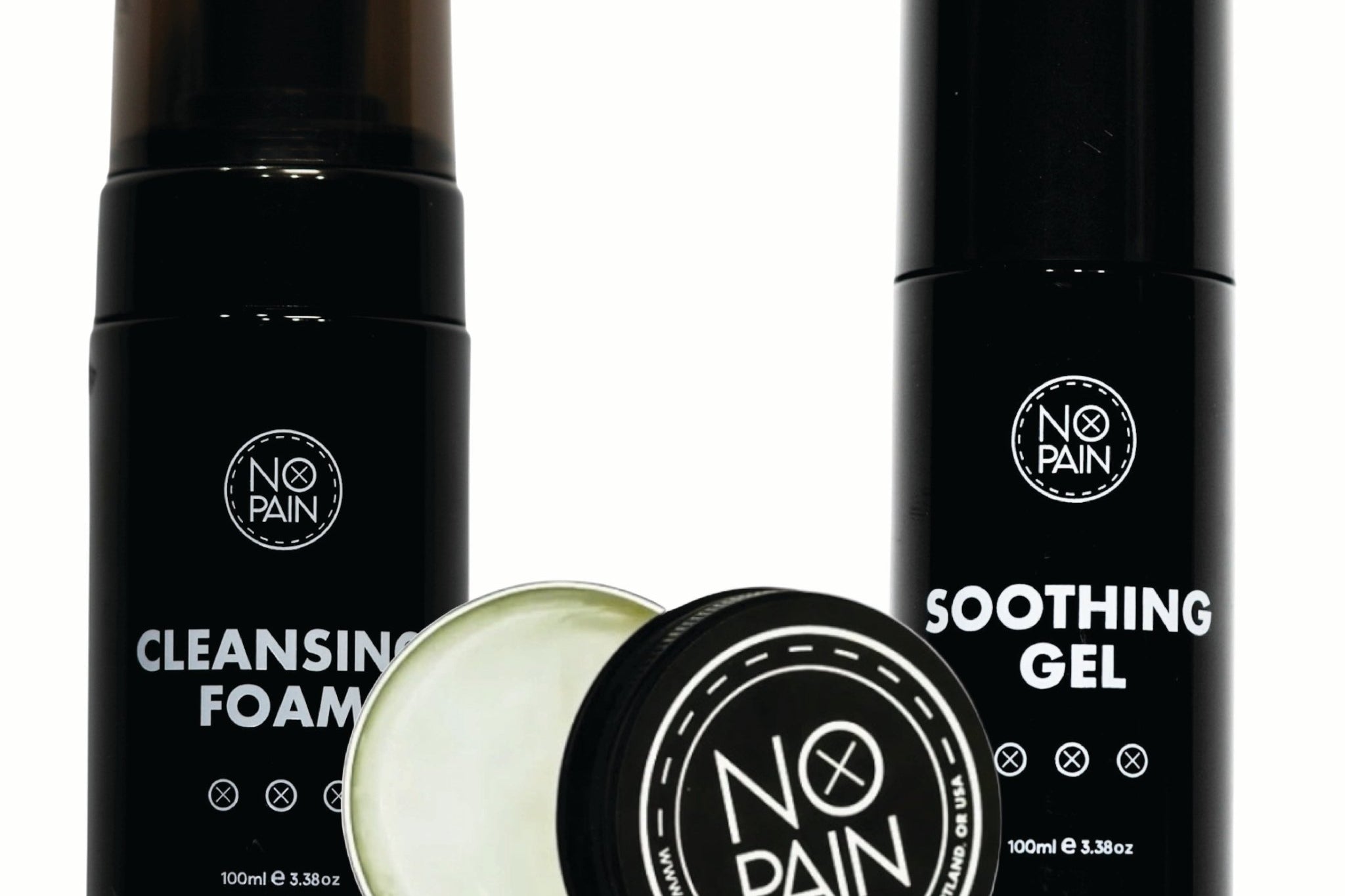
A lightweight, cooling gel for the first few days of healing. Calms redness and inflammation, absorbs without residue, and won't trap moisture or suffocate the skin the way heavy balms do in the early stage.
Days 3-7: Transition to Balm
Around day two or three, the weeping stops. The surface starts to dry out, and the peeling phase begins. Thin, flaky pieces of skin will start lifting off. This is your signal to switch products.
Now a nourishing balm takes over. Balm is oil-and-butter based, so it creates a breathable barrier that locks in moisture without the drawbacks of petroleum. The result is a softer, more controlled peel with less scabbing and less ink loss.
Routine for Days 3-7:
Keep washing twice daily. After each wash, apply balm instead of gel. Same thin-layer approach: you want the skin hydrated, not coated. Three times daily is fine if the skin feels tight or dry between washes.
The most important rule of this phase: do not pick. Every piece of skin you peel off before it's ready pulls ink with it. Let the skin fall on its own. The peel should be thin, flaky, and almost transparent. If you see thick, raised scabs, you're not hydrating enough.

A nourishing, non-comedogenic balm for the peeling phase and beyond. Shea butter and natural oils support skin renewal without clogging pores or trapping moisture.
Weeks 2-3: The Milky Phase
By the end of week one, the peeling is mostly done. The skin looks healed on the surface. Then week two hits and the tattoo looks dull, faded, and slightly milky. If this is your first tattoo, this phase can be alarming.
It's not permanent. What you're seeing is the new skin that's grown over the tattoo. It's thinner and less transparent than your normal skin and it scatters the light differently. As it matures over the next few weeks, it clears up and the tattoo looks sharp again.
Keep applying balm twice daily through weeks two and three. The hydration keeps the new skin supple as it matures and speeds up how fast it clears. You can also switch to a fragrance-free, alcohol-free body lotion at this point if you prefer (the skin is closed, so either works).
Keep washing, keep hydrating. The tattoo is more fragile than it looks during this window.
Week 6 and Beyond: Fully Healed
A tattoo is fully healed when the skin texture matches the surrounding area completely. For most placements on body fat or muscle, that's around six weeks. Bony placements (ribs, hands, feet, spine) can take eight to twelve weeks. Large, heavily worked pieces take longer.
Once healed, sunscreen becomes your most important product. UV radiation breaks down tattoo pigment faster than anything else. Lighter colors fade first, but black ink goes grey over time too. SPF 30 or higher, broad-spectrum, applied any time the tattoo will be in the sun.
Don't put sunscreen on a healing tattoo. The chemicals irritate fresh skin. Cover healing tattoos with clothing instead.
What to Avoid at Every Stage
Soaking. Baths, swimming pools, hot tubs, and the sea are all off-limits until the tattoo is fully healed. Short showers are fine; soaking softens the scab layer and pulls ink. Two to four weeks minimum, longer for large pieces.
Direct sun. A healing tattoo sunburned is a healing tattoo ruined. Cover it or stay out of it. Once healed, sunscreen every time.
Gym and heavy sweating. Sweat is not sterile and contains bacteria. It also loosens the scab layer. Light walking is fine. Heavy cardio, contact sports, and anything that causes the tattoo to flex repeatedly (like a leg tattoo on a runner) should wait until the surface is closed, usually ten to fourteen days.
Picking, scratching, rubbing. Every temptation in this direction should be ignored. The itch during weeks one and two is from nerve regeneration under the skin. Scratching doesn't address that. Applying cold balm or gel soothes it without the damage.
Petroleum products and thick ointments. Vaseline, A+D, and standard Aquaphor are too occlusive for a fresh tattoo. They trap moisture and plasma under the skin and create the conditions for milia (small white bumps) and bacterial growth. Fine on fully healed skin; wrong tool for a healing one.
Fragrance. Any product with a scent contains compounds that irritate healing skin. Keep everything fragrance-free for at least two weeks.
Red Flags: When to See a Doctor
A tattoo should get better every day, not worse. Normal healing means redness and swelling that reduce by day three, plasma weep that stops by day three, and a peel that starts around day four and finishes by week two.
See a doctor if you notice any of the following:
Pain that increases after day two. Inflammation from a fresh tattoo peaks in the first 24 to 48 hours and then subsides. Pain that gets worse after that is not normal.
Spreading redness. Some redness immediately around the tattoo is normal. Red streaks moving away from the tattoo toward the body are a sign of spreading infection and need immediate medical attention.
Thick yellow or green discharge. Clear or slightly ink-tinted plasma is normal. Thick, opaque yellow or green fluid is pus. That's an infection, not a normal heal.
Fever or feeling unwell. Systemic symptoms mean a systemic infection. Go to a doctor the same day.
If you're unsure whether something is normal, contact your tattoo artist. They've seen thousands of heals and can usually tell you over a photo whether something warrants concern.
Frequently Asked Questions
How often should I wash my new tattoo?
Twice daily for the first two weeks: morning and night, always after washing your hands. If the tattoo gets dirty (sweat, outdoor dust, anything touching it), wash it then too. Over-washing is less of a problem than under-washing, but twice daily is the right baseline.
Can I shower with a new tattoo?
Yes, from day one. Keep showers short and lukewarm. Don't let the showerhead blast directly onto the tattoo. Don't soak; stand so the water runs off rather than pools on the tattoo. Baths, pools, and the sea are off-limits until fully healed.
Why does my tattoo look dull and faded in week two?
That's the milky phase. New skin has grown over the tattoo and it's temporarily less transparent than your normal skin, which makes the tattoo look flat and faded. It's not permanent. The new skin matures and clears over weeks two and three. Keep hydrating and it speeds up.
When can I go back to the gym?
Light walking and non-contact activity: as soon as it doesn't hurt. Heavy cardio, anything that causes significant sweating directly on the tattoo, and contact sports: wait until the surface is fully closed, usually ten to fourteen days. Bony placements that flex a lot (hands, feet, inner arm) need longer.
Is it normal for the tattoo to peel?
Yes. Peeling is normal and good: it's the body shedding the top layer of damaged skin. What's not normal is thick, raised scabbing, which usually means the tattoo wasn't kept hydrated enough in the first few days. Thin, flaky peeling that mostly happens on its own is the sign of a well-hydrated heal.
Do I really need separate gel and balm, or can I use one product the whole time?
The two-phase approach exists for a reason. In the first few days, the skin is weeping and needs to breathe. A lightweight gel soothes without blocking the wound. From day three onward, the skin is closing and needs deeper, more sustained moisture. A balm locks that in. Using balm too early traps plasma; using gel too long misses the hydration the rebuilding skin needs. They're different tools for different stages.